What Is ECG? A Complete Beginner Guide (Simple & Clinical)
If you’re starting cardiology, one tool you’ll hear about everywhere is the ECG.
But what exactly is it—and why is it so important?
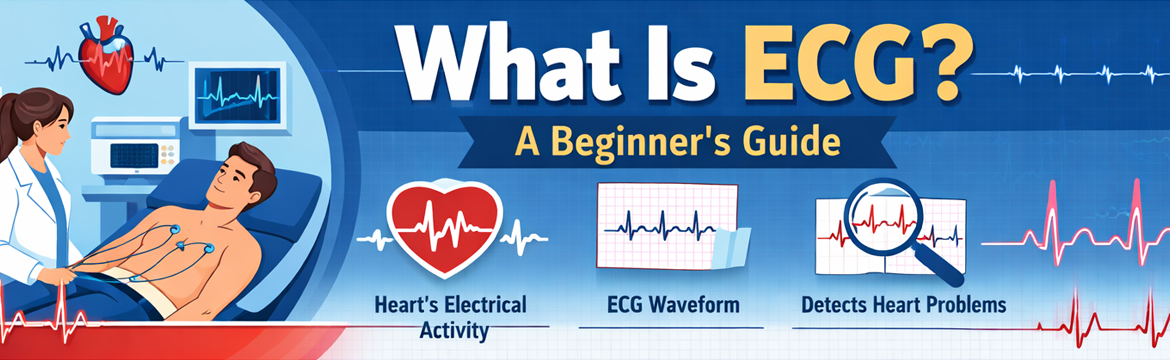
What Is an ECG?
ECG stands for Electrocardiogram.
It is a test that records the electrical activity of the heart.
Every time your heart beats, it generates tiny electrical signals. An ECG captures these signals and displays them as waves on a graph.
Why Is ECG Important?
An ECG is one of the most powerful and widely used tools in medicine.
It helps doctors:
- Detect heart rhythm problems (arrhythmias)
- Diagnose heart attacks
- Monitor heart function
- Identify structural abnormalities
The best part? It’s quick, painless, and non-invasive.
How Does an ECG Work?
Small sensors called electrodes are placed on your:
- Chest
- Arms
- Legs
These electrodes detect electrical signals and send them to a machine, which converts them into a waveform.
Understanding the ECG Wave (Basic Idea)
An ECG tracing looks like a repeating pattern of waves.
The main components are:
- P wave → Atrial contraction
- QRS complex → Ventricular contraction
- T wave → Heart recovery (repolarization)
Think of it as a story of each heartbeat.
When Is an ECG Used?
Doctors use ECG in many situations:
- Chest pain
- Shortness of breath
- Palpitations
- Dizziness or fainting
- Routine checkups
What Can ECG Detect?
An ECG can help identify:
- Arrhythmias (irregular heartbeat)
- Myocardial infarction (heart attack)
- Electrolyte imbalances
- Conduction abnormalities
Clinical Insight (What Beginners Miss)
Many beginners focus on memorizing waves—but miss the big picture.
ECG is not just lines on paper.
It’s a clinical decision tool.
A normal-looking ECG doesn’t always mean a healthy patient—and an abnormal ECG doesn’t always mean a dangerous condition.
Context is everything.
How to Start Learning ECG (Step-by-Step)
If you’re a beginner, follow this order:
- Learn normal ECG first
- Understand heart rhythm basics
- Study intervals (PR, QRS, QT)
- Practice simple cases daily
Consistency matters more than complexity.
Pro Tip
Don’t try to learn everything at once.
Focus on pattern recognition + repetition
That’s how real doctors master ECG.
Ready to Master ECG?
This is just the beginning.
If you want to:
- Read ECG confidently
- Diagnose real cases
- Think like a clinician
Join the Full ECG + Cardiology Training at CardiologyMaster.com
References
- American Heart Association (AHA)
- Mayo Clinic – Electrocardiogram (ECG)
- Goldberger’s Clinical Electrocardiography
- Life in the Fast Lane – ECG Library

.png)
.webp)
.webp)